Never lost
between the lines:
the science of the narrative thread
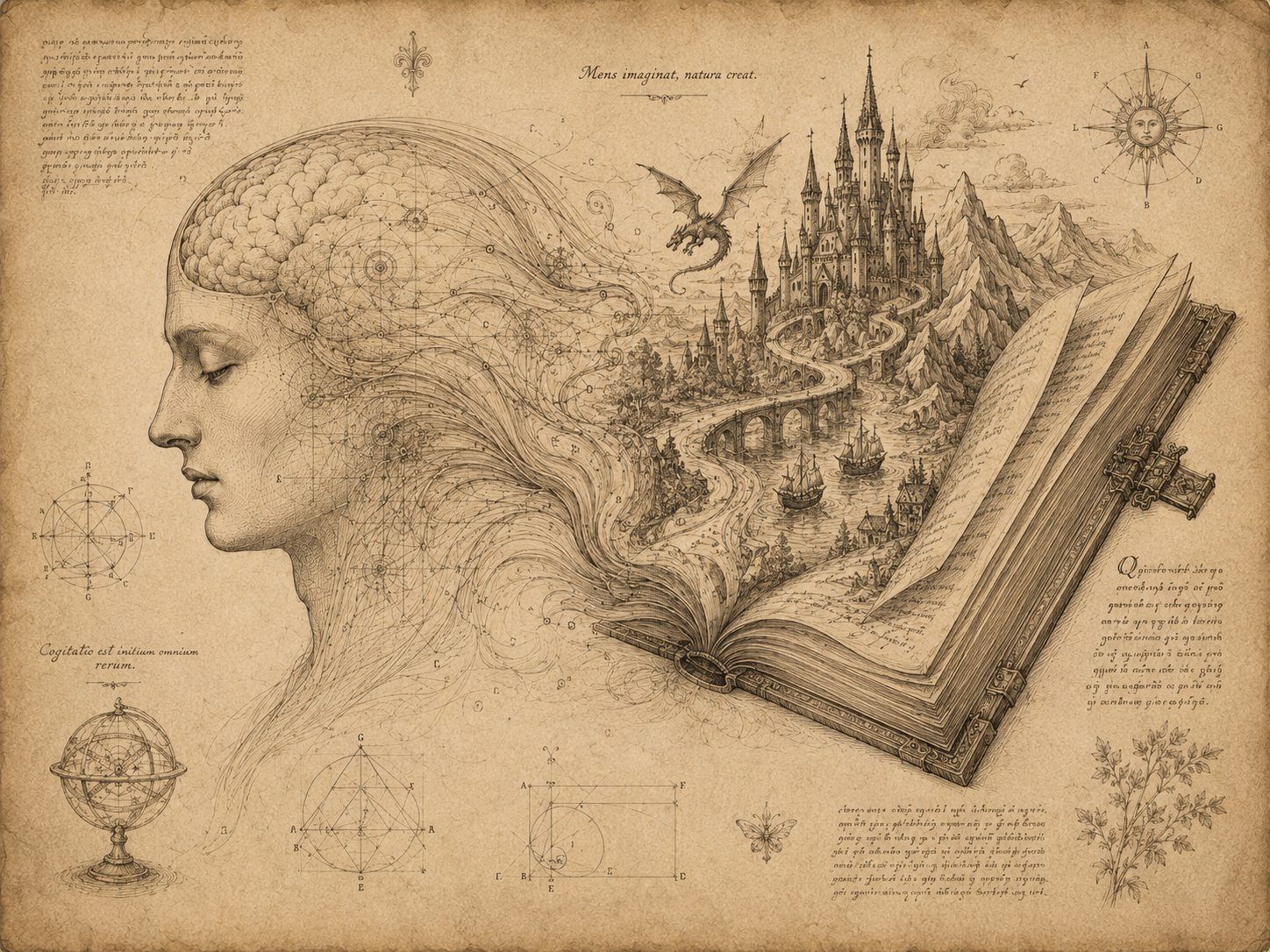
The problem with fragmented reading isn't lack of time. Every time you close a book, the narrative universe between the pages begins to fade, and re-entering requires a cognitive effort that often blocks us. Fabulè was built to solve exactly this problem, drawing on one of the most robust research traditions in cognitive psychology.
"Narrative transportation is a state in which all attention, emotion, and mental imagery converge on the story's events. Transported readers return from the journey changed."
Green & Appel — Advances in Experimental Social Psychology, 2024
Narrative transportation:
entering another world
In the 1990s, cognitive scientist Richard Gerrig coined a precise metaphor: the reader is a traveller. They enter a mental place built by the author, live through its events, and return carrying new memories, emotions, even new beliefs about the world.
Green and Brock (2000) turned this metaphor into measurable science. Their Transportation Scale assesses four simultaneous dimensions: cognitive attention, emotional engagement, mental imagery, and loss of awareness of the surrounding environment. Decades of studies confirm: the more we are transported, the more the story changes us.
"Stories invite recipients to enter a narrative world, and people are changed — at least temporarily — by the experience of living in that world."
Gerrig (1993), as cited in Green & Appel (2024)
The most recent research has clarified a crucial detail: transportation is not a stable state. Immersion varies moment to moment, grows in tense passages, settles during pauses, and breaks when a distraction arrives or the book is closed.
Transported readers do not completely abandon the real world: they integrate their autobiographical experiences with narrative events, in what researchers call remindings, personal resonances that enhance immersion when they align with the story and disrupt it when they conflict.
Green & Appel (2024)
Narrative Transportation: How Stories Shape How We See Ourselves and the World. Advances in Experimental Social Psychology, 70, 1–82. DOI: 10.1016/bs.aesp.2024.03.002
The three processes that keep
the journey alive
Narrative transportation is not a single mental faculty: it is the convergence of three processes that must remain synchronised for the story to hold us inside it. All three can be interrupted and all three can be reactivated.
Cognitive attention
The mind continuously maps the causal structure of the narrative: characters, goals, consequences, timeline. Every prolonged pause fades this map and forces a reconstruction from scratch.
Emotional engagement
We respond emotionally to characters as if they were real. Identification with the protagonist is one of the strongest predictors of transportation and depends on continuity of the narrative thread.
Mental imagery
The brain builds vivid mental images of places, faces, atmospheres. EEG studies show the simultaneous activation of working memory, emotion, and imagination during intense reading.
Fragmented reading
breaks transportation
We live in an era of fragmented reading: a few minutes on the train, half an hour in the evening, then days of pause. The problem isn't quantity: it's that every interruption forces the mind to restart the work of immersion almost from scratch.
Green and Appel (2024) document that transportation is sensitive to situational variables: the reading context, distractions, time elapsed since the last session. When the narrative arc has cooled, the three pillars must be rebuilt and this cognitive effort is often what stops us before we even reopen the book.
"If the reader's personal experience contradicts the story, transportation is disrupted. If it resonates with it, transportation is amplified."
Bilandzic (2006), in Green & Appel (2024)
There is a second relevant phenomenon: retrospective imaginative involvement (Slater et al., 2018), the continuous thinking about the narrative world even after closing the book. Highly transported readers continue to live the story away from the page and this posthumous engagement fuels the desire to return to reading.
But if fragmented reading prevents achieving deep transportation, this virtuous cycle never activates. The reader remains on the surface, struggles to connect with characters, and ultimately abandons the book halfway through.
Fabulè was created to break this spiral. It doesn't add time to reading: it restores the depth with which you return inside every story.
Green & Appel (2024) close their review by pointing to technology and artificial intelligence as the most promising research directions for the future of narrative transportation.
Fabulè is that research
applied to every reader
An AI assistant that doesn't replace reading, but safeguards it by reconstructing the narrative context, reactivating characters and plots, and keeping the thread alive between sessions. Without ever anticipating what you haven't yet read.
Four tools,
one single goal
Every feature of Fabulè responds to a mechanism documented by narrative transportation research. These are not product choices: they are direct implications of the psychology of reading.
Anti-Spoiler Protocol
The AI knows the reader's exact position in the book and filters everything that comes after. Transportation depends on narrative tension: an involuntary anticipation destroys it irreparably. Source: Green & Appel (2024), §3.1.
Reading History Memory
Contextual summary calibrated to the chapter reached: characters, relationships, key events. Reconstructs the cognitive map of the story before the reader reopens the book. Directly addresses the problem of the dynamic nature of transportation.
Natural dialogue
Free questions, not pre-packaged answers. Dialogue activates remindings, autobiographical resonances that enhance transportation when the reader connects the story to their own experience.
Maps, genealogies and timelines
Support for complex plots: character relationships, geographies, narrative timelines. Restores mental imagery — the third pillar of transportation — which fades during longer reading pauses.
From every scientific construct
to a concrete feature
The theory of narrative transportation is not merely a cultural backdrop for us: it is the architectural blueprint of Fabulè.
| Construct (Green & Appel 2024) | The reader's problem | Fabulè's response | Ref. |
|---|---|---|---|
| Dynamic nature of transportation | Immersion collapses after every prolonged pause between sessions | Anti-spoiler contextual recap that reconstructs the narrative map before reopening the book Reading Memory | §1.2.1 |
| Remindings & personal resonance | The reader cannot emotionally reconnect with the story | Free dialogue that reactivates personal connections with the book's themes and characters Natural Chat | §1.2.2 |
| Mental imagery | Faces, places and atmospheres fade between sessions | Evocative descriptions, maps and genealogies calibrated to the reading point Maps & Plots | §1.3 |
| Retrospective involvement | The book ends up in a drawer and thoughts about it fade | Reflection prompts that keep the dialogue with the story alive outside the reading session Natural Chat | §1.4 |
| Character identification | Emotional connection to protagonists is lost in complex plots | Character profiles updated to the chapter reached, with relationships and developments Reading Memory | §1.5.1 |
| Narrative tension and suspense | An accidental spoiler destroys the experience before it's even read | Rigorous filtering of any future information relative to the reader's position Anti-Spoiler | §3.1 |
Three steps to re-enter
the flow of the story
Find your book
Scan the barcode, search by title or upload the file. Fabulè recognises thousands of titles and indexes them for full narrative support.
Indicate your reading point
Type the last four or five words you read. Fabulè locates exactly where you are in the story and activates the anti-spoiler filter.
Ask your questions
Ask anything you like: characters, relationships, past events, symbolism. You'll receive precise answers, in the language of your choice, without ever anticipating what you haven't yet read.
The foundations
of the research
Fabulè is built on decades of empirical research in cognitive and communication psychology, not on market intuitions.
Green, M.C. & Appel, M. (2024)
Narrative transportation: How stories shape how we see ourselves and the world. Advances in Experimental Social Psychology, 70, 1–82. University of Buffalo & University of Würzburg. DOI: 10.1016/bs.aesp.2024.03.002
Green, M.C. & Brock, T.C. (2000)
The role of transportation in the persuasiveness of public narratives. Journal of Personality and Social Psychology, 79(5), 701–721. The foundational paper of the Transportation Scale.
Slater, M.D. et al. (2018)
Retrospective imaginative involvement: the narrative engagement that continues after closing the book and fuels the desire to return to reading.
Thomas, R. & Grigsby, T. (2024)
Narrative transportation: A systematic literature review and future research agenda. Psychology & Marketing, 41, 1805–1819. Systematic review of 95 peer-reviewed articles.
Return to your book
exactly where you left it in your heart
Not just at the right chapter, but in the right emotional state. Fabulè brings you back into the story in seconds, without spoilers.